9 Encoding Information
\(\newcommand{\footnotename}{footnote}\)
\(\def \LWRfootnote {1}\)
\(\newcommand {\footnote }[2][\LWRfootnote ]{{}^{\mathrm {#1}}}\)
\(\newcommand {\footnotemark }[1][\LWRfootnote ]{{}^{\mathrm {#1}}}\)
\(\let \LWRorighspace \hspace \)
\(\renewcommand {\hspace }{\ifstar \LWRorighspace \LWRorighspace }\)
\(\newcommand {\TextOrMath }[2]{#2}\)
\(\newcommand {\mathnormal }[1]{{#1}}\)
\(\newcommand \ensuremath [1]{#1}\)
\(\newcommand {\LWRframebox }[2][]{\fbox {#2}} \newcommand {\framebox }[1][]{\LWRframebox } \)
\(\newcommand {\setlength }[2]{}\)
\(\newcommand {\addtolength }[2]{}\)
\(\newcommand {\setcounter }[2]{}\)
\(\newcommand {\addtocounter }[2]{}\)
\(\newcommand {\arabic }[1]{}\)
\(\newcommand {\number }[1]{}\)
\(\newcommand {\noalign }[1]{\text {#1}\notag \\}\)
\(\newcommand {\cline }[1]{}\)
\(\newcommand {\directlua }[1]{\text {(directlua)}}\)
\(\newcommand {\luatexdirectlua }[1]{\text {(directlua)}}\)
\(\newcommand {\protect }{}\)
\(\def \LWRabsorbnumber #1 {}\)
\(\def \LWRabsorbquotenumber "#1 {}\)
\(\newcommand {\LWRabsorboption }[1][]{}\)
\(\newcommand {\LWRabsorbtwooptions }[1][]{\LWRabsorboption }\)
\(\def \mathchar {\ifnextchar "\LWRabsorbquotenumber \LWRabsorbnumber }\)
\(\def \mathcode #1={\mathchar }\)
\(\let \delcode \mathcode \)
\(\let \delimiter \mathchar \)
\(\def \oe {\unicode {x0153}}\)
\(\def \OE {\unicode {x0152}}\)
\(\def \ae {\unicode {x00E6}}\)
\(\def \AE {\unicode {x00C6}}\)
\(\def \aa {\unicode {x00E5}}\)
\(\def \AA {\unicode {x00C5}}\)
\(\def \o {\unicode {x00F8}}\)
\(\def \O {\unicode {x00D8}}\)
\(\def \l {\unicode {x0142}}\)
\(\def \L {\unicode {x0141}}\)
\(\def \ss {\unicode {x00DF}}\)
\(\def \SS {\unicode {x1E9E}}\)
\(\def \dag {\unicode {x2020}}\)
\(\def \ddag {\unicode {x2021}}\)
\(\def \P {\unicode {x00B6}}\)
\(\def \copyright {\unicode {x00A9}}\)
\(\def \pounds {\unicode {x00A3}}\)
\(\let \LWRref \ref \)
\(\renewcommand {\ref }{\ifstar \LWRref \LWRref }\)
\( \newcommand {\multicolumn }[3]{#3}\)
\(\require {textcomp}\)
\(\newcommand {\intertext }[1]{\text {#1}\notag \\}\)
\(\let \Hat \hat \)
\(\let \Check \check \)
\(\let \Tilde \tilde \)
\(\let \Acute \acute \)
\(\let \Grave \grave \)
\(\let \Dot \dot \)
\(\let \Ddot \ddot \)
\(\let \Breve \breve \)
\(\let \Bar \bar \)
\(\let \Vec \vec \)
\(\renewcommand {\vec }{\boldsymbol }\)
\(\newcommand {\Edge }{\ensuremath {\,\textemdash \,}}\)
\(\newcommand \Const [1]{\text {\textsf {#1}}}\)
\(\DeclareMathOperator {\lerp }{lerp}\)
\(\DeclareMathOperator {\bitlen }{bitlen}\)
\(\DeclareMathOperator {\sign }{sign}\)
\(\newcommand {\I }{\mathrm {i}}\)
\(\newcommand \AND {\mathbin {\&}}\)
\(\newcommand \OR {\mathbin {|}}\)
\(\newcommand \XOR {\mathbin {{}^{\wedge }}}\)
\(\newcommand \shl {\ll }\)
\(\newcommand \shr {\ggg }\)
\(\newcommand \asr {\gg }\)
\(\newcommand \NOT {\ensuremath {\mathord {\sim }}}\)
\(\newcommand {\isep }{\mathrel {{.}\,{.}}}\)
\(\newcommand {\Id }[1]{\mathit {#1}}\)
\(\newcommand {\const }[1]{\mathsf {#1}}\)
\(\newcommand {\algorithmname }[1]{\text {\textsc {#1}}}\)
\(\newcommand {\bits }[1]{\text {#1}}\)
\(\newcommand {\hexa }[1]{\mathtt {0x#1}}\)
\(\newcommand {\num }[1]{#1}\)
\(\newcommand {\qed }{\quad \square }\)
\(\newcommand {\idiv }[2]{\lfloor #1/#2\rfloor }\)
\(\newcommand \attribdot {\ensuremath {\mkern 1.5mu.\mkern 1.5mu}}\)
\(\newcommand \attribxr [2]{#1\attribdot \text {#2}}\)
\(\newcommand \attribir [2]{\Id {#1}\attribdot \text {#2}}\)
\(\newcommand \attribii [2]{\Id {#1}\attribdot \Id {#2}}\)
\(\newcommand \textsc [1]{#1}\)
\(\require {colortbl}\)
\(\let \LWRorigcolumncolor \columncolor \)
\(\renewcommand {\columncolor }[2][named]{\LWRorigcolumncolor [#1]{#2}\LWRabsorbtwooptions }\)
\(\let \LWRorigrowcolor \rowcolor \)
\(\renewcommand {\rowcolor }[2][named]{\LWRorigrowcolor [#1]{#2}\LWRabsorbtwooptions }\)
\(\let \LWRorigcellcolor \cellcolor \)
\(\renewcommand {\cellcolor }[2][named]{\LWRorigcellcolor [#1]{#2}\LWRabsorbtwooptions }\)
\(\newcommand {\tcbset }[1]{}\)
\(\newcommand {\tcbsetforeverylayer }[1]{}\)
\(\newcommand {\tcbox }[2][]{\boxed {\text {#2}}}\)
\(\newcommand {\tcboxfit }[2][]{\boxed {#2}}\)
\(\newcommand {\tcblower }{}\)
\(\newcommand {\tcbline }{}\)
\(\newcommand {\tcbtitle }{}\)
\(\newcommand {\tcbsubtitle [2][]{\mathrm {#2}}}\)
\(\newcommand {\tcboxmath }[2][]{\boxed {#2}}\)
\(\newcommand {\tcbhighmath }[2][]{\boxed {#2}}\)
\(\newcommand {\toprule }[1][]{\hline }\)
\(\let \midrule \toprule \)
\(\let \bottomrule \toprule \)
\(\def \LWRbooktabscmidruleparen (#1)#2{}\)
\(\newcommand {\LWRbooktabscmidrulenoparen }[1]{}\)
\(\newcommand {\cmidrule }[1][]{\ifnextchar (\LWRbooktabscmidruleparen \LWRbooktabscmidrulenoparen }\)
\(\newcommand {\morecmidrules }{}\)
\(\newcommand {\specialrule }[3]{\hline }\)
\(\newcommand {\addlinespace }[1][]{}\)
\(\newcommand {\LWRsubmultirow }[2][]{#2}\)
\(\newcommand {\LWRmultirow }[2][]{\LWRsubmultirow }\)
\(\newcommand {\multirow }[2][]{\LWRmultirow }\)
\(\newcommand {\mrowcell }{}\)
\(\newcommand {\mcolrowcell }{}\)
\(\newcommand {\STneed }[1]{}\)
\(\newcommand {\LWRldelimtwo }[1][]{\text {#1}~\LWRbigdelim }\)
\(\newcommand {\LWRldelimone }[2][]{\LWRldelimtwo }\)
\(\def \ldelim #1#2{\def \LWRbigdelim {#1}\LWRldelimone }\)
\(\newcommand {\LWRrdelimtwo }[1][]{\LWRbigdelim ~\text {#1}}\)
\(\newcommand {\LWRrdelimone }[2][]{\LWRrdelimtwo }\)
\(\def \rdelim #1#2{\def \LWRbigdelim {#1}\LWRrdelimone }\)
\(\let \symnormal \mathit \)
\(\let \symliteral \mathrm \)
\(\let \symbb \mathbb \)
\(\let \symbbit \mathbb \)
\(\let \symcal \mathcal \)
\(\let \symscr \mathscr \)
\(\let \symfrak \mathfrak \)
\(\let \symsfup \mathsf \)
\(\let \symsfit \mathit \)
\(\let \symbfsf \mathbf \)
\(\let \symbfup \mathbf \)
\(\newcommand {\symbfit }[1]{\boldsymbol {#1}}\)
\(\let \symbfcal \mathcal \)
\(\let \symbfscr \mathscr \)
\(\let \symbffrak \mathfrak \)
\(\let \symbfsfup \mathbf \)
\(\newcommand {\symbfsfit }[1]{\boldsymbol {#1}}\)
\(\let \symup \mathrm \)
\(\let \symbf \mathbf \)
\(\let \symit \mathit \)
\(\let \symsf \symsfit \)
\(\let \symtt \mathtt \)
\(\let \symbffrac \mathbffrac \)
\(\newcommand {\mathfence }[1]{\mathord {#1}}\)
\(\newcommand {\mathover }[1]{#1}\)
\(\newcommand {\mathunder }[1]{#1}\)
\(\newcommand {\mathaccent }[1]{#1}\)
\(\newcommand {\mathbotaccent }[1]{#1}\)
\(\newcommand {\mathalpha }[1]{\mathord {#1}}\)
\(\def\Alpha{\unicode{x1D6E2}}\)
\(\def\Beta{\unicode{x1D6E3}}\)
\(\def\Gamma{\unicode{x1D6E4}}\)
\(\def\Digamma{\mathit{\unicode{x03DC}}}\)
\(\def\Delta{\unicode{x1D6E5}}\)
\(\def\Epsilon{\unicode{x1D6E6}}\)
\(\def\Zeta{\unicode{x1D6E7}}\)
\(\def\Eta{\unicode{x1D6E8}}\)
\(\def\Theta{\unicode{x1D6E9}}\)
\(\def\Vartheta{\unicode{x1D6F3}}\)
\(\def\Iota{\unicode{x1D6EA}}\)
\(\def\Kappa{\unicode{x1D6EB}}\)
\(\def\Lambda{\unicode{x1D6EC}}\)
\(\def\Mu{\unicode{x1D6ED}}\)
\(\def\Nu{\unicode{x1D6EE}}\)
\(\def\Xi{\unicode{x1D6EF}}\)
\(\def\Omicron{\unicode{x1D6F0}}\)
\(\def\Pi{\unicode{x1D6F1}}\)
\(\def\Rho{\unicode{x1D6F2}}\)
\(\def\Sigma{\unicode{x1D6F4}}\)
\(\def\Tau{\unicode{x1D6F5}}\)
\(\def\Upsilon{\unicode{x1D6F6}}\)
\(\def\Phi{\unicode{x1D6F7}}\)
\(\def\Chi{\unicode{x1D6F8}}\)
\(\def\Psi{\unicode{x1D6F9}}\)
\(\def\Omega{\unicode{x1D6FA}}\)
\(\def\alpha{\unicode{x1D6FC}}\)
\(\def\beta{\unicode{x1D6FD}}\)
\(\def\varbeta{\unicode{x03D0}}\)
\(\def\gamma{\unicode{x1D6FE}}\)
\(\def\digamma{\mathit{\unicode{x03DD}}}\)
\(\def\delta{\unicode{x1D6FF}}\)
\(\def\epsilon{\unicode{x1D716}}\)
\(\def\varepsilon{\unicode{x1D700}}\)
\(\def\zeta{\unicode{x1D701}}\)
\(\def\eta{\unicode{x1D702}}\)
\(\def\theta{\unicode{x1D703}}\)
\(\def\vartheta{\unicode{x1D717}}\)
\(\def\iota{\unicode{x1D704}}\)
\(\def\kappa{\unicode{x1D705}}\)
\(\def\varkappa{\unicode{x1D718}}\)
\(\def\lambda{\unicode{x1D706}}\)
\(\def\mu{\unicode{x1D707}}\)
\(\def\nu{\unicode{x1D708}}\)
\(\def\xi{\unicode{x1D709}}\)
\(\def\omicron{\unicode{x1D70A}}\)
\(\def\pi{\unicode{x1D70B}}\)
\(\def\varpi{\unicode{x1D71B}}\)
\(\def\rho{\unicode{x1D70C}}\)
\(\def\varrho{\unicode{x1D71A}}\)
\(\def\sigma{\unicode{x1D70E}}\)
\(\def\varsigma{\unicode{x1D70D}}\)
\(\def\tau{\unicode{x1D70F}}\)
\(\def\upsilon{\unicode{x1D710}}\)
\(\def\phi{\unicode{x1D719}}\)
\(\def\varphi{\unicode{x1D711}}\)
\(\def\chi{\unicode{x1D712}}\)
\(\def\psi{\unicode{x1D713}}\)
\(\def\omega{\unicode{x1D714}}\)
\(\def\upAlpha{\unicode{x0391}}\)
\(\def\upBeta{\unicode{x0392}}\)
\(\def\upGamma{\unicode{x0393}}\)
\(\def\upDigamma{\unicode{x03DC}}\)
\(\def\upDelta{\unicode{x0394}}\)
\(\def\upEpsilon{\unicode{x0395}}\)
\(\def\upZeta{\unicode{x0396}}\)
\(\def\upEta{\unicode{x0397}}\)
\(\def\upTheta{\unicode{x0398}}\)
\(\def\upVartheta{\unicode{x03F4}}\)
\(\def\upIota{\unicode{x0399}}\)
\(\def\upKappa{\unicode{x039A}}\)
\(\def\upLambda{\unicode{x039B}}\)
\(\def\upMu{\unicode{x039C}}\)
\(\def\upNu{\unicode{x039D}}\)
\(\def\upXi{\unicode{x039E}}\)
\(\def\upOmicron{\unicode{x039F}}\)
\(\def\upPi{\unicode{x03A0}}\)
\(\def\upVarpi{\unicode{x03D6}}\)
\(\def\upRho{\unicode{x03A1}}\)
\(\def\upSigma{\unicode{x03A3}}\)
\(\def\upTau{\unicode{x03A4}}\)
\(\def\upUpsilon{\unicode{x03A5}}\)
\(\def\upPhi{\unicode{x03A6}}\)
\(\def\upChi{\unicode{x03A7}}\)
\(\def\upPsi{\unicode{x03A8}}\)
\(\def\upOmega{\unicode{x03A9}}\)
\(\def\itAlpha{\unicode{x1D6E2}}\)
\(\def\itBeta{\unicode{x1D6E3}}\)
\(\def\itGamma{\unicode{x1D6E4}}\)
\(\def\itDigamma{\mathit{\unicode{x03DC}}}\)
\(\def\itDelta{\unicode{x1D6E5}}\)
\(\def\itEpsilon{\unicode{x1D6E6}}\)
\(\def\itZeta{\unicode{x1D6E7}}\)
\(\def\itEta{\unicode{x1D6E8}}\)
\(\def\itTheta{\unicode{x1D6E9}}\)
\(\def\itVartheta{\unicode{x1D6F3}}\)
\(\def\itIota{\unicode{x1D6EA}}\)
\(\def\itKappa{\unicode{x1D6EB}}\)
\(\def\itLambda{\unicode{x1D6EC}}\)
\(\def\itMu{\unicode{x1D6ED}}\)
\(\def\itNu{\unicode{x1D6EE}}\)
\(\def\itXi{\unicode{x1D6EF}}\)
\(\def\itOmicron{\unicode{x1D6F0}}\)
\(\def\itPi{\unicode{x1D6F1}}\)
\(\def\itRho{\unicode{x1D6F2}}\)
\(\def\itSigma{\unicode{x1D6F4}}\)
\(\def\itTau{\unicode{x1D6F5}}\)
\(\def\itUpsilon{\unicode{x1D6F6}}\)
\(\def\itPhi{\unicode{x1D6F7}}\)
\(\def\itChi{\unicode{x1D6F8}}\)
\(\def\itPsi{\unicode{x1D6F9}}\)
\(\def\itOmega{\unicode{x1D6FA}}\)
\(\def\upalpha{\unicode{x03B1}}\)
\(\def\upbeta{\unicode{x03B2}}\)
\(\def\upvarbeta{\unicode{x03D0}}\)
\(\def\upgamma{\unicode{x03B3}}\)
\(\def\updigamma{\unicode{x03DD}}\)
\(\def\updelta{\unicode{x03B4}}\)
\(\def\upepsilon{\unicode{x03F5}}\)
\(\def\upvarepsilon{\unicode{x03B5}}\)
\(\def\upzeta{\unicode{x03B6}}\)
\(\def\upeta{\unicode{x03B7}}\)
\(\def\uptheta{\unicode{x03B8}}\)
\(\def\upvartheta{\unicode{x03D1}}\)
\(\def\upiota{\unicode{x03B9}}\)
\(\def\upkappa{\unicode{x03BA}}\)
\(\def\upvarkappa{\unicode{x03F0}}\)
\(\def\uplambda{\unicode{x03BB}}\)
\(\def\upmu{\unicode{x03BC}}\)
\(\def\upnu{\unicode{x03BD}}\)
\(\def\upxi{\unicode{x03BE}}\)
\(\def\upomicron{\unicode{x03BF}}\)
\(\def\uppi{\unicode{x03C0}}\)
\(\def\upvarpi{\unicode{x03D6}}\)
\(\def\uprho{\unicode{x03C1}}\)
\(\def\upvarrho{\unicode{x03F1}}\)
\(\def\upsigma{\unicode{x03C3}}\)
\(\def\upvarsigma{\unicode{x03C2}}\)
\(\def\uptau{\unicode{x03C4}}\)
\(\def\upupsilon{\unicode{x03C5}}\)
\(\def\upphi{\unicode{x03D5}}\)
\(\def\upvarphi{\unicode{x03C6}}\)
\(\def\upchi{\unicode{x03C7}}\)
\(\def\uppsi{\unicode{x03C8}}\)
\(\def\upomega{\unicode{x03C9}}\)
\(\def\italpha{\unicode{x1D6FC}}\)
\(\def\itbeta{\unicode{x1D6FD}}\)
\(\def\itvarbeta{\unicode{x03D0}}\)
\(\def\itgamma{\unicode{x1D6FE}}\)
\(\def\itdigamma{\mathit{\unicode{x03DD}}}\)
\(\def\itdelta{\unicode{x1D6FF}}\)
\(\def\itepsilon{\unicode{x1D716}}\)
\(\def\itvarepsilon{\unicode{x1D700}}\)
\(\def\itzeta{\unicode{x1D701}}\)
\(\def\iteta{\unicode{x1D702}}\)
\(\def\ittheta{\unicode{x1D703}}\)
\(\def\itvartheta{\unicode{x1D717}}\)
\(\def\itiota{\unicode{x1D704}}\)
\(\def\itkappa{\unicode{x1D705}}\)
\(\def\itvarkappa{\unicode{x1D718}}\)
\(\def\itlambda{\unicode{x1D706}}\)
\(\def\itmu{\unicode{x1D707}}\)
\(\def\itnu{\unicode{x1D708}}\)
\(\def\itxi{\unicode{x1D709}}\)
\(\def\itomicron{\unicode{x1D70A}}\)
\(\def\itpi{\unicode{x1D70B}}\)
\(\def\itvarpi{\unicode{x1D71B}}\)
\(\def\itrho{\unicode{x1D70C}}\)
\(\def\itvarrho{\unicode{x1D71A}}\)
\(\def\itsigma{\unicode{x1D70E}}\)
\(\def\itvarsigma{\unicode{x1D70D}}\)
\(\def\ittau{\unicode{x1D70F}}\)
\(\def\itupsilon{\unicode{x1D710}}\)
\(\def\itphi{\unicode{x1D719}}\)
\(\def\itvarphi{\unicode{x1D711}}\)
\(\def\itchi{\unicode{x1D712}}\)
\(\def\itpsi{\unicode{x1D713}}\)
\(\def\itomega{\unicode{x1D714}}\)
\(\let \lparen (\)
\(\let \rparen )\)
\(\newcommand {\cuberoot }[1]{\,{}^3\!\!\sqrt {#1}}\,\)
\(\newcommand {\fourthroot }[1]{\,{}^4\!\!\sqrt {#1}}\,\)
\(\newcommand {\longdivision }[1]{\mathord {\unicode {x027CC}#1}}\)
\(\newcommand {\mathcomma }{,}\)
\(\newcommand {\mathcolon }{:}\)
\(\newcommand {\mathsemicolon }{;}\)
\(\newcommand {\overbracket }[1]{\mathinner {\overline {\ulcorner {#1}\urcorner }}}\)
\(\newcommand {\underbracket }[1]{\mathinner {\underline {\llcorner {#1}\lrcorner }}}\)
\(\newcommand {\overbar }[1]{\mathord {#1\unicode {x00305}}}\)
\(\newcommand {\ovhook }[1]{\mathord {#1\unicode {x00309}}}\)
\(\newcommand {\ocirc }[1]{\mathord {#1\unicode {x0030A}}}\)
\(\newcommand {\candra }[1]{\mathord {#1\unicode {x00310}}}\)
\(\newcommand {\oturnedcomma }[1]{\mathord {#1\unicode {x00312}}}\)
\(\newcommand {\ocommatopright }[1]{\mathord {#1\unicode {x00315}}}\)
\(\newcommand {\droang }[1]{\mathord {#1\unicode {x0031A}}}\)
\(\newcommand {\leftharpoonaccent }[1]{\mathord {#1\unicode {x020D0}}}\)
\(\newcommand {\rightharpoonaccent }[1]{\mathord {#1\unicode {x020D1}}}\)
\(\newcommand {\vertoverlay }[1]{\mathord {#1\unicode {x020D2}}}\)
\(\newcommand {\leftarrowaccent }[1]{\mathord {#1\unicode {x020D0}}}\)
\(\newcommand {\annuity }[1]{\mathord {#1\unicode {x020E7}}}\)
\(\newcommand {\widebridgeabove }[1]{\mathord {#1\unicode {x020E9}}}\)
\(\newcommand {\asteraccent }[1]{\mathord {#1\unicode {x020F0}}}\)
\(\newcommand {\threeunderdot }[1]{\mathord {#1\unicode {x020E8}}}\)
\(\newcommand {\Bbbsum }{\mathop {\unicode {x2140}}\limits }\)
\(\newcommand {\oiint }{\mathop {\unicode {x222F}}\limits }\)
\(\newcommand {\oiiint }{\mathop {\unicode {x2230}}\limits }\)
\(\newcommand {\intclockwise }{\mathop {\unicode {x2231}}\limits }\)
\(\newcommand {\ointclockwise }{\mathop {\unicode {x2232}}\limits }\)
\(\newcommand {\ointctrclockwise }{\mathop {\unicode {x2233}}\limits }\)
\(\newcommand {\varointclockwise }{\mathop {\unicode {x2232}}\limits }\)
\(\newcommand {\leftouterjoin }{\mathop {\unicode {x27D5}}\limits }\)
\(\newcommand {\rightouterjoin }{\mathop {\unicode {x27D6}}\limits }\)
\(\newcommand {\fullouterjoin }{\mathop {\unicode {x27D7}}\limits }\)
\(\newcommand {\bigbot }{\mathop {\unicode {x27D8}}\limits }\)
\(\newcommand {\bigtop }{\mathop {\unicode {x27D9}}\limits }\)
\(\newcommand {\xsol }{\mathop {\unicode {x29F8}}\limits }\)
\(\newcommand {\xbsol }{\mathop {\unicode {x29F9}}\limits }\)
\(\newcommand {\bigcupdot }{\mathop {\unicode {x2A03}}\limits }\)
\(\newcommand {\bigsqcap }{\mathop {\unicode {x2A05}}\limits }\)
\(\newcommand {\conjquant }{\mathop {\unicode {x2A07}}\limits }\)
\(\newcommand {\disjquant }{\mathop {\unicode {x2A08}}\limits }\)
\(\newcommand {\bigtimes }{\mathop {\unicode {x2A09}}\limits }\)
\(\newcommand {\modtwosum }{\mathop {\unicode {x2A0A}}\limits }\)
\(\newcommand {\sumint }{\mathop {\unicode {x2A0B}}\limits }\)
\(\newcommand {\intbar }{\mathop {\unicode {x2A0D}}\limits }\)
\(\newcommand {\intBar }{\mathop {\unicode {x2A0E}}\limits }\)
\(\newcommand {\fint }{\mathop {\unicode {x2A0F}}\limits }\)
\(\newcommand {\cirfnint }{\mathop {\unicode {x2A10}}\limits }\)
\(\newcommand {\awint }{\mathop {\unicode {x2A11}}\limits }\)
\(\newcommand {\rppolint }{\mathop {\unicode {x2A12}}\limits }\)
\(\newcommand {\scpolint }{\mathop {\unicode {x2A13}}\limits }\)
\(\newcommand {\npolint }{\mathop {\unicode {x2A14}}\limits }\)
\(\newcommand {\pointint }{\mathop {\unicode {x2A15}}\limits }\)
\(\newcommand {\sqint }{\mathop {\unicode {x2A16}}\limits }\)
\(\newcommand {\intlarhk }{\mathop {\unicode {x2A17}}\limits }\)
\(\newcommand {\intx }{\mathop {\unicode {x2A18}}\limits }\)
\(\newcommand {\intcap }{\mathop {\unicode {x2A19}}\limits }\)
\(\newcommand {\intcup }{\mathop {\unicode {x2A1A}}\limits }\)
\(\newcommand {\upint }{\mathop {\unicode {x2A1B}}\limits }\)
\(\newcommand {\lowint }{\mathop {\unicode {x2A1C}}\limits }\)
\(\newcommand {\bigtriangleleft }{\mathop {\unicode {x2A1E}}\limits }\)
\(\newcommand {\zcmp }{\mathop {\unicode {x2A1F}}\limits }\)
\(\newcommand {\zpipe }{\mathop {\unicode {x2A20}}\limits }\)
\(\newcommand {\zproject }{\mathop {\unicode {x2A21}}\limits }\)
\(\newcommand {\biginterleave }{\mathop {\unicode {x2AFC}}\limits }\)
\(\newcommand {\bigtalloblong }{\mathop {\unicode {x2AFF}}\limits }\)
\(\newcommand {\arabicmaj }{\mathop {\unicode {x1EEF0}}\limits }\)
\(\newcommand {\arabichad }{\mathop {\unicode {x1EEF1}}\limits }\)
9.3 Huffman Coding
In the previous section we saw how to decode the codewords of a prefix code by searching for a path from root of the corresponding binary tree to one of its leaf nodes. This one-to-one correspondence between prefix codes and binary trees has
another important consequence: It allows us to design prefix codes by constructing binary trees with certain desirable properties. In fact, it even allows us to construct optimal prefix codes that encode a given sequence of letters using the fewest bits possible.
To see how this works, let’s return to the message “ABRACADABRA” and try to find an optimal prefix code for the individual letters. The five letters A, B, C, D, R occur at the following frequencies:
| . |
|---|
| symbol |
A |
B |
R |
C |
D |
| frequency |
5 |
2 |
2 |
1 |
1 |
so the total length of the bit encoding of “ABRACADABRA” is
\(\seteqnumber{0}{9.}{1}\)
\begin{equation*}
L = 5l_A + 2l_B + 2l_R + 1l_C + 1l_D,
\end{equation*}
where \(l_s\) denotes the length of the codeword of symbol \(s\). For a prefix code, the length of a symbol \(l_s\) is equal to the distance of the corresponding leaf node from the root of the tree, its depth \(d_s\) in the tree. Finding an optimal prefix code is therefore equivalent to constructing a binary tree that minimizes the following weighted sum of depths:
\(\seteqnumber{0}{9.}{1}\)
\begin{equation*}
L = 5d_A + 2d_B + 2d_R + 1d_C + 1d_D.
\end{equation*}
It turns out that there is a simple algorithm for constructing such a tree. It is based on the observation that the two least frequent symbols, in this example C and D, must be placed at a maximum distance from the root of the tree. We can therefore start by populating the lowest
levels of the tree with the least common symbols and successively add more frequent symbols into the upper levels of the tree. Let’s start by creating leaf nodes for all symbols and sorting them by their frequency:
We now construct a binary tree with these five leaves from the bottom up. First, we combine the two least frequent symbols by making them children of a new inner node:
The label of the new node is obtained by adding the frequencies of its two children, in this case \(1+1=2\). This cumulative frequency reflects the fact that we are no longer trying to construct optimal codewords for C and D separately but to find an optimal prefix for both of them.
In the next step, we again combine two nodes with the smallest label. We pick any two of the three nodes with label \(2\) and combine them into a new node with cumulative frequency \(4\):
In this example, we have combined the nodes for B and R, but any other pair of nodes with label 2 would be just as good.
The two nodes with the lowest frequency are now the roots of the two trees we created in the previous steps. We combine them to produce a tree with frequency \(6\) and reorder the nodes:
We then combine the two remaining nodes to form the root of the final tree:
This final tree is called a Huffman tree, and by following the paths from the root to each leaf we obtain the corresponding Huffman code. The codeword of A is 1 since we reach the node by going right once, the codeword of B is 000 since we go left three times, and so on:
| . |
|---|
| symbol |
A |
B |
R |
C |
D |
| codeword |
1 |
000 |
001 |
010 |
011 |
How much better is this code than the ad-hoc prefix code we constructed in the previous section? Encoding ABRACADABRA produces the following bit sequence of length \(23\)
In this case, the Huffman code saves \(5\) bits compared to the 28 bits required before, which amounts to a respectable 18% improvement. For a given table of symbols and frequencies, no other prefix code produces a shorter bit sequence.2
Algorithm 9.1 summarizes the algorithm for constructing Huffman trees. The input of the algorithm is a list of symbols \(S\) and a list of associated frequencies \(F\).3 In the first phase
of the algorithm, we create one leaf node for each symbol, and in the second phase we repeatedly combine pairs of nodes to build the Huffman tree from the bottom up. The algorithm presented here assumes that there are at least two symbols; Exercise 9.8 discusses how to construct a Huffman tree when there is just a single symbol.
Construct the Huffman tree for a list \(S\) of symbols and a list of frequencies \(F\), where \(F[s]\) denotes the frequency of the symbol \(s\in S\). The algorithm returns the root of the resulting binary tree.
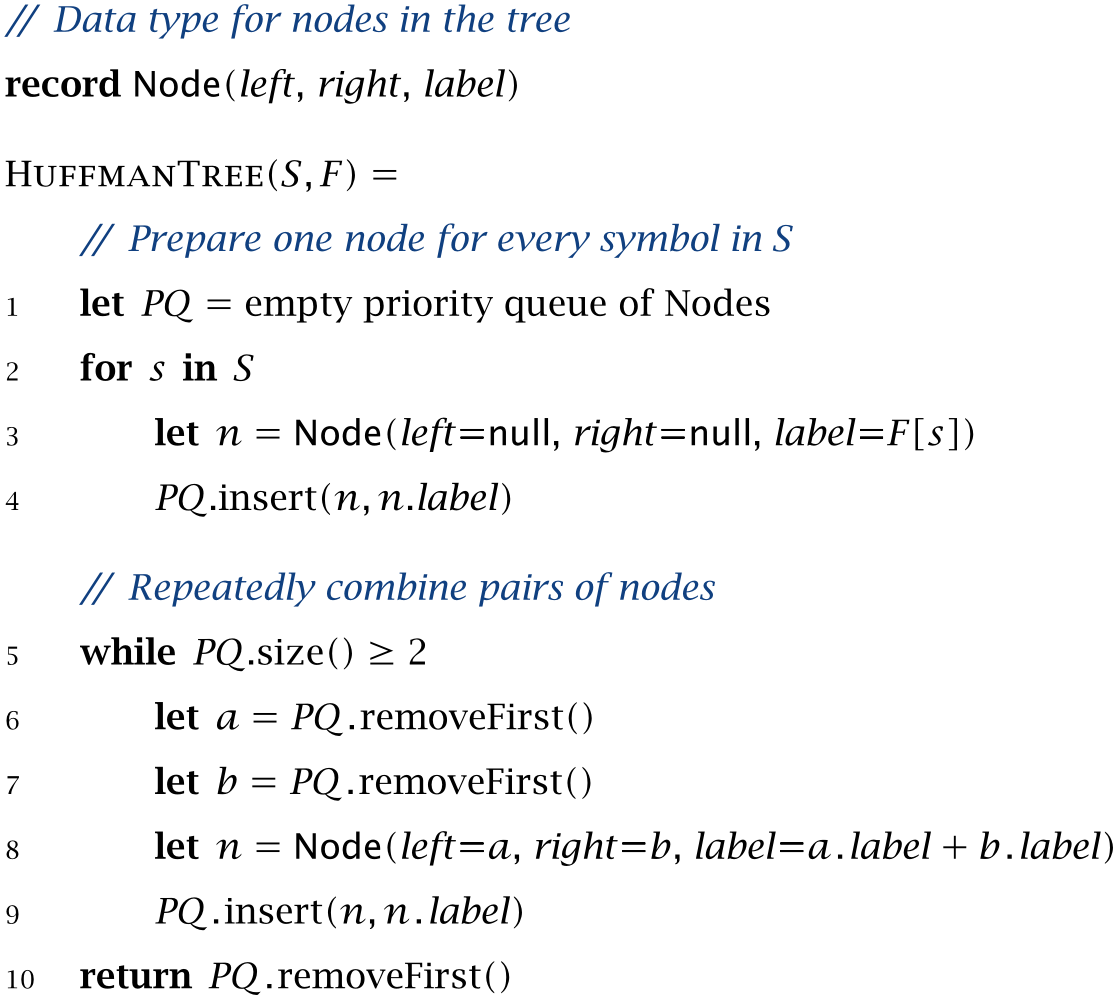
As mentioned, the tree constructed by HuffmanTree always produces an optimal prefix code, but in many cases there are other trees and codes that are just as good. To see this, first note that our choice to
make \(a\) the left subtree and \(b\) the right subtree of \(n\) in line 8 is completely arbitrary: Exchanging the two subtrees merely flips a few bits in the resulting codewords. In addition, there may be multiple nodes
with the same value of label at the front of the priority queue, and multiple choices for the nodes \(a\) and \(b\) in lines 6 and 7, which leads to
additional variations that are equally good. Exercise 9.10 asks you to construct all the possible Huffman trees for a particular set of symbols and frequencies.
In practice, it is often desirable to implement Huffman’s algorithm in such a way that it always returns the same tree for a given set of symbols and frequencies. We will discuss how to do this in the following section.
Exercises
Exercise 9.8. Consider a message that consists of a single repeated symbol. What is the optimal prefix code for such a message? How does the corresponding Huffman tree look, and how do you have to modify the HuffmanTree algorithm to accommodate this special case?
Exercise 9.9.Consider the following code that treats the word ABRACADABRA as a single symbol with the codeword 0:
| . |
|---|
| symbol |
ABRACADABRA |
| codeword |
0 |
This code is appears to be even better than any Huffman code, since it compresses ABRACADABRA down to a single bit! What’s the catch?
Exercise 9.10. Consider again the following frequency table:
| . |
|---|
| symbol |
A |
B |
R |
C |
D |
| frequency |
5 |
2 |
2 |
1 |
1 |
How many different Huffman trees can be constructed for this table? Which of the resulting codes encodes “ABRACADABRA” using the fewest bits?